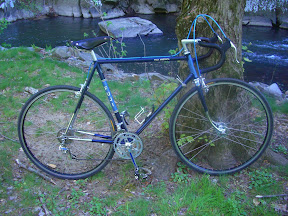
Usually, Auction Watch speaks for itself, but this week there are two sales worthy of note, a 1976 Fuji America, quite original including saddle, and a 1980 Fuji Cambridge III. Neither of these models come up for sale very often, especially in original configuration, so this may be of interest to readers.
Plus, there is a Gran Tourer, a perennial favorite and a great gateway acquisition into Fuji collecting.
The America is a little big for me, in addition to the fact that I already have a very nice 1980 model. The Cambridge is a different story, just the thing for running up the street to Snider's Grocery, whose entry sign proudly proclaims (I'm not making this up), "Meat That Can't Be Beat".
Monday, February 9, 2009


Saturday, February 7, 2009
Painted Engravings for the Masses
The past day or two, there was an interesting thread in the Classic & Vintage forum on bikeforums.com about how to paint engravings, like one sees on all those tony Masis and Colnagos hanging out on Classic Rendezvous.
The basic technique is to paint it without a lot of care about the edges, then after about 5 minutes, rub down the high spots with a popsicle stick dipped in mineral spirits.
So I tried it, worked like a champ first time. The front derailleur, btw, is a NOS Suntour Compe V, I've fallen in love with high normal in the front.
And yes, there is a connection between the yellow on this derailleur set and the yellow brake cable housing I purchased today....
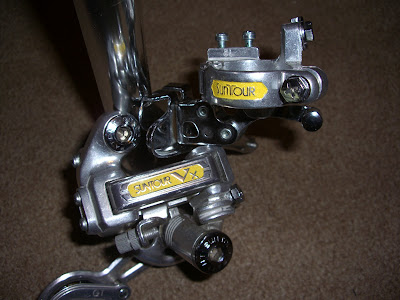
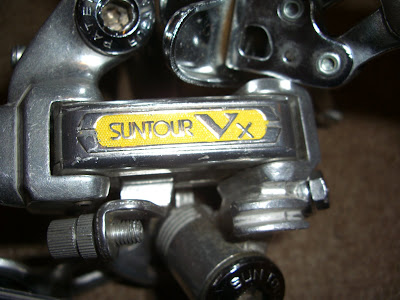
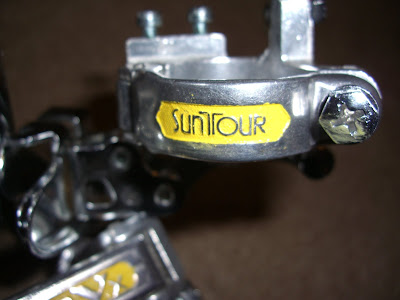
The basic technique is to paint it without a lot of care about the edges, then after about 5 minutes, rub down the high spots with a popsicle stick dipped in mineral spirits.
So I tried it, worked like a champ first time. The front derailleur, btw, is a NOS Suntour Compe V, I've fallen in love with high normal in the front.
And yes, there is a connection between the yellow on this derailleur set and the yellow brake cable housing I purchased today....


Support Your Local Bike Shop
Just wanted to dole out an Otaku attaboy (otakuboy?) to the guys and gals at City Bikes, located conveniently at the intersection of the Capital Crescent Trail and Connecticut Avenue. Why? Well, they are a straight ahead, modern retail shop doling out comfort bikes, Sunday go to the racers, fixies, but:
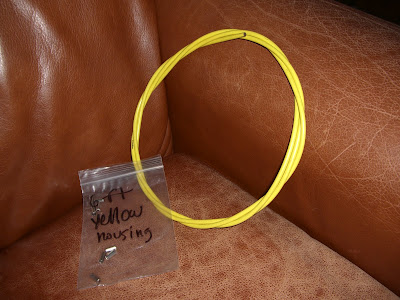
So at the parts/service desk, I ask for yellow brake cable housing, six feet please, with 6 ferrules. The fellow at the counter and I began joshing about the cosmic improbability of them actually stocking this, but before we could savor too many chuckles, the counter-person's colleague joined us holding this, with helpful explanatory text:
So, I think, ok, you wisenheimers, try this next one on for size, and ask for some dropout adjuster screws to fit the long, beautifully chromed forged Campagnolo dropouts on my secret project. Without breaking a sweat, they presented these:
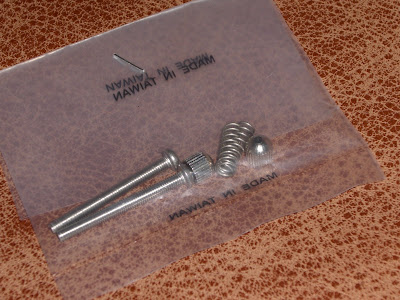
Not only did they have what I needed, they were actually better than the ones I was going to pick up next week from Velo Orange as depicted below. The screws and springs on the VO ones are black, the City Bike ones are silver, silver always trumps black, although VO makes a valiant attempt with shinier knurled adjustment knobs.

That got me thinking that maybe I should still get the VO ones, use their adjustment knobs, since nothing is too good for the forthcoming secret project. But then I decided that even obsession has limits.
- If you ask for something offbeat or retro, they don't roll their eyes, fix you with a blank stare, or suggest you "upgrade".
- With a surprisingly frequent regularity, they will actually have what is asked for despite not displaying the slightest bit of institutional interest in vintage cycles.
So at the parts/service desk, I ask for yellow brake cable housing, six feet please, with 6 ferrules. The fellow at the counter and I began joshing about the cosmic improbability of them actually stocking this, but before we could savor too many chuckles, the counter-person's colleague joined us holding this, with helpful explanatory text:

So, I think, ok, you wisenheimers, try this next one on for size, and ask for some dropout adjuster screws to fit the long, beautifully chromed forged Campagnolo dropouts on my secret project. Without breaking a sweat, they presented these:

Not only did they have what I needed, they were actually better than the ones I was going to pick up next week from Velo Orange as depicted below. The screws and springs on the VO ones are black, the City Bike ones are silver, silver always trumps black, although VO makes a valiant attempt with shinier knurled adjustment knobs.

That got me thinking that maybe I should still get the VO ones, use their adjustment knobs, since nothing is too good for the forthcoming secret project. But then I decided that even obsession has limits.
Thursday, February 5, 2009
Sunny, Clear
and a high of 25 degrees in Washington D.C. Perfect day to cycle to that business lunch in Bethesda. The bike is my 1985 Trek 620 warhorse. A veteran of years of commuting and long rides, much of it off pavement, it is equipped with a lot of interesting, bulletproof parts like a Schmidt Dynohub. Someday I'll get a post up about this faithful friend.
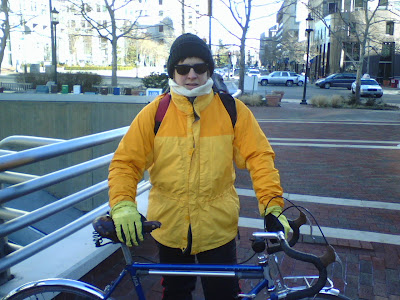
All you have to do is block the wind, not really bundle up. I'm just wearing a normal sweater under the uninsulated shell, no long underwear or anything, and a set of jogging windbreaker lowers over my jeans. My regular cycling boat shoes, along with cap, gloves, and scarf, finish the ensemble.
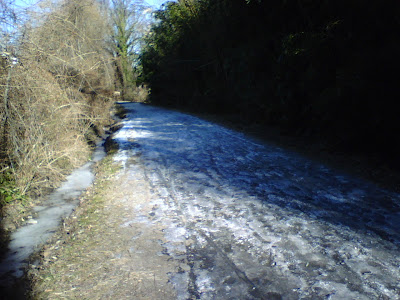
Gotta watch the ice though, the Georgetown Branch Trail (the unpaved extension of the Capital Crescent between Downtown Silver Spring and Bethesda), had some tricky parts. I actually rode over the section below, which was probably pretty stupid at my age and all.
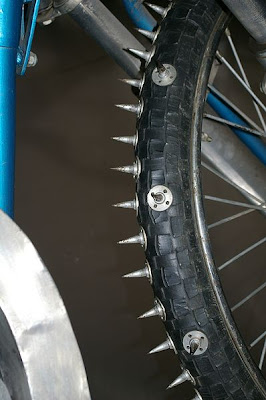
I always tell anyone who will listen to me that I would much rather ride in 30 degree weather than 90, one doesn't get all sweaty. Nobody, around here, anyhow, maybe they would in Minnesota or one of those places where they do psycho ice racing on viciously studded tires, seems to believe me, which is ok. I get the trail to myself, very therapeutic and calming.
I do wonder what it is like to run around on some of those wicked looking ice tires.

All you have to do is block the wind, not really bundle up. I'm just wearing a normal sweater under the uninsulated shell, no long underwear or anything, and a set of jogging windbreaker lowers over my jeans. My regular cycling boat shoes, along with cap, gloves, and scarf, finish the ensemble.
Gotta watch the ice though, the Georgetown Branch Trail (the unpaved extension of the Capital Crescent between Downtown Silver Spring and Bethesda), had some tricky parts. I actually rode over the section below, which was probably pretty stupid at my age and all.

I always tell anyone who will listen to me that I would much rather ride in 30 degree weather than 90, one doesn't get all sweaty. Nobody, around here, anyhow, maybe they would in Minnesota or one of those places where they do psycho ice racing on viciously studded tires, seems to believe me, which is ok. I get the trail to myself, very therapeutic and calming.
I do wonder what it is like to run around on some of those wicked looking ice tires.

1972 Fuji Finest Headset and Sugino Mighty Crankset
The 1972 Fuji Finest headse, whose removal was described here, cleaned up nicely. Chrome is flawless.
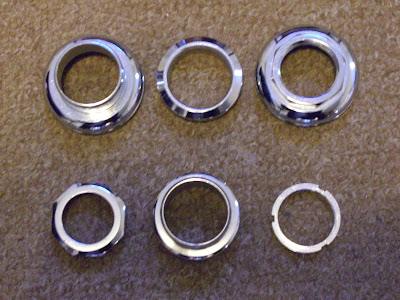
Unfortunately, the crown and fork races are brinelled beyond useability. Hmmm....
One option is to leave this on a shelf for display, it is very pretty. The other would be to find some races that fit the bike and would work with this headset. The fork race mount diameter on the Finest is 27.0 mm, JIS standard instead of the more common 26.4 ISO standard making this into an even more daunting scavenger hunt.
Today, the morning post brought a very nice Sugino Mighty crankset. These Campagnolo Nuovo Record inspired cranksets, with 144 BCD, graced many high end Japanese bikes in the 1970's. Later, for reasons unclear to Fuji Otaku, they became popular with the BMX crowd.
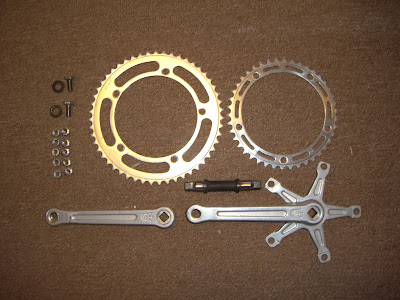
Very nice condition, no gouging/scratches, just the typical shoe rub on the arms. The bonus is the 109 mm spindle, something not always easy to find, but necessary for proper chainline with this crank.
A later variant, called the Super Mighty, had cutouts on the crank spider arms where there are simply depressions on the Mighty. Due to this, a Mighty may be converted to a triple with the machining services of Elliot Bay Bicycles, who will machine a 74 mm BCD hole pattern in the spider arm depressions for a suprisingly reasonable amount.
However, if one likes the Mighty, but wants a triple without machining hassles and the difficulty of finding 144 BCD rings, there is always the classic 110 BCD Might Tour, as seen on this Fuji America:
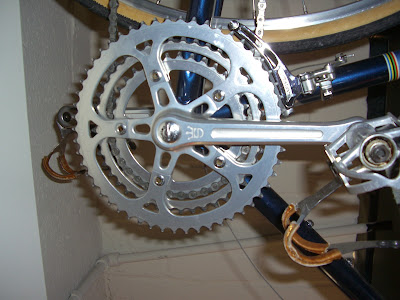
These are somewhat scarce, but turn up from time to time. I'm looking for another, so if anyone has one with which they are willing to part, please let me know.
Also, should anyone have the black plastic snap on spindle caps that graced earlier MKS road pedals, please let me know. The newer, screw in silver ones don't work. My set disappeared one day when the bicycle was locked up in downtown Bethesda, Maryland. I'm pretty sure they were swiped, I have a hard time believing they both mysteriously fell off the same day.

Unfortunately, the crown and fork races are brinelled beyond useability. Hmmm....
One option is to leave this on a shelf for display, it is very pretty. The other would be to find some races that fit the bike and would work with this headset. The fork race mount diameter on the Finest is 27.0 mm, JIS standard instead of the more common 26.4 ISO standard making this into an even more daunting scavenger hunt.
Today, the morning post brought a very nice Sugino Mighty crankset. These Campagnolo Nuovo Record inspired cranksets, with 144 BCD, graced many high end Japanese bikes in the 1970's. Later, for reasons unclear to Fuji Otaku, they became popular with the BMX crowd.

Very nice condition, no gouging/scratches, just the typical shoe rub on the arms. The bonus is the 109 mm spindle, something not always easy to find, but necessary for proper chainline with this crank.
A later variant, called the Super Mighty, had cutouts on the crank spider arms where there are simply depressions on the Mighty. Due to this, a Mighty may be converted to a triple with the machining services of Elliot Bay Bicycles, who will machine a 74 mm BCD hole pattern in the spider arm depressions for a suprisingly reasonable amount.
However, if one likes the Mighty, but wants a triple without machining hassles and the difficulty of finding 144 BCD rings, there is always the classic 110 BCD Might Tour, as seen on this Fuji America:

These are somewhat scarce, but turn up from time to time. I'm looking for another, so if anyone has one with which they are willing to part, please let me know.
Also, should anyone have the black plastic snap on spindle caps that graced earlier MKS road pedals, please let me know. The newer, screw in silver ones don't work. My set disappeared one day when the bicycle was locked up in downtown Bethesda, Maryland. I'm pretty sure they were swiped, I have a hard time believing they both mysteriously fell off the same day.
Wednesday, February 4, 2009
Minty Touring Series IV

Tuesday, February 3, 2009
A Boy and His Headset Removal Tools
In these tough times, who can afford the snazzy special tools featured in so many cycling blogs? Well, we like to keep it real here at Fuji Otaku, so today we have some tips about something everyone can do to make sure their vintage bike habit isn't stealing food from their children's mouth.
Fuji Otaku's 1972 Finest has been slowly transitioning from a coherent bicycle to an increasingly barren frameset next to a box of baggied parts. Tonight was the last little bit of dissassembly, removing the headset from the frame.
Here are tools:
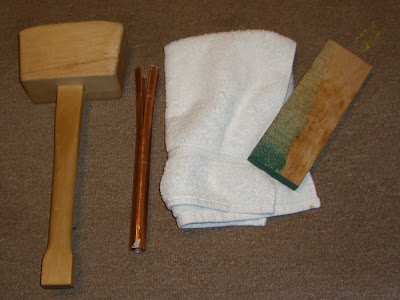
The mallet and the copper tube headset remover are homemade. The towel is temporarily AWOL from the upstairs linen closet, and the other scrap of wood is just that, a piece of wood from the scrap pile.
The details of making the mallet will be left to someone's woodworking blog. The real star in this posting is the headset remover, which started off as a 1 foot section of 3/4" copper pipe. The Fuji Otaku machine shop, using a hacksaw, cut 4 slits about 5" long, then carefully bent the resulting quarter section wings as seen below:
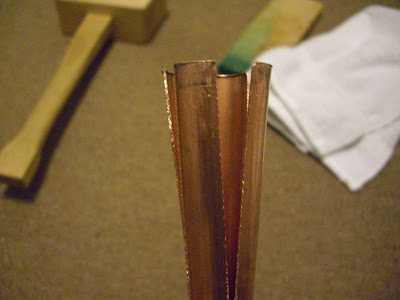
To use this precision tool, insert the non-cut end into the head tube. Pull it up through the head tube until the wings clear the headset piece. You'll hear a distinct click when this happens. Then, holding the scrap piece of wood with the towel, put the bare end of the scrap on top of the uncut end of the copper tube. Finish up by banging away on the scrap wood with the mallet until the pressed in headset piece comes free.
The scrap wood just keeps the copper tube from taking core samples from the business end of one's fine handmade, rock maple mallet. Should you be wondering why one should hold the scrap wood with a towel, try it without the towel and find out.
To remove the race from the forks, get the forks in a secure upside down position and drift the race off with the scrap wood piece and mallet. This means tapping it alternately on different sides of the fork so that it slowly moves off the fork mounting surface.
On the Finest, the upper tube race came off quite easily, while the lower cup required a lot of vigorous blows to coax it out from what appears to have been 37 years of repose. The fork race tapped off with a few firm blows.
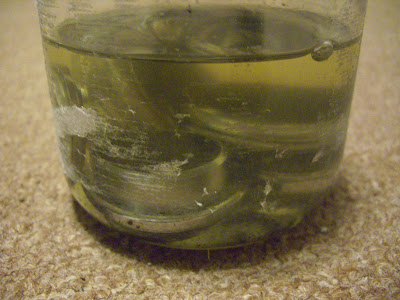
The headset was so grody it was immediately popped into a jar of mineral spirits for a soak:
After this headset is cleaned up, some pictures will be posted of this nice chrome Nuovo Record clone. A relic of a simpler time, it is devoid of any manufacturer identification. Imagine that, a high quality headset without any branding at all. What on earth could those neolithics been thinking back then?
The Finest frame is now disassembled completely, another milestone on its slow journey to a destination that has not yet revealed itself in full:
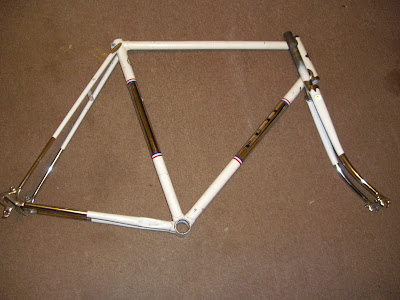
However things do end up for this bike, it does appear to have a shiny future.
And fittingly, this post quite coincidentally comes on the one year anniversary of the loss of Sheldon Brown, who doggedly championed pragmatic and economical solutions to bicycle maintenance tasks.
Rest in peace, Sheldon, you informed and inspired countless cyclists.
Fuji Otaku's 1972 Finest has been slowly transitioning from a coherent bicycle to an increasingly barren frameset next to a box of baggied parts. Tonight was the last little bit of dissassembly, removing the headset from the frame.
Here are tools:

The mallet and the copper tube headset remover are homemade. The towel is temporarily AWOL from the upstairs linen closet, and the other scrap of wood is just that, a piece of wood from the scrap pile.
The details of making the mallet will be left to someone's woodworking blog. The real star in this posting is the headset remover, which started off as a 1 foot section of 3/4" copper pipe. The Fuji Otaku machine shop, using a hacksaw, cut 4 slits about 5" long, then carefully bent the resulting quarter section wings as seen below:

To use this precision tool, insert the non-cut end into the head tube. Pull it up through the head tube until the wings clear the headset piece. You'll hear a distinct click when this happens. Then, holding the scrap piece of wood with the towel, put the bare end of the scrap on top of the uncut end of the copper tube. Finish up by banging away on the scrap wood with the mallet until the pressed in headset piece comes free.
The scrap wood just keeps the copper tube from taking core samples from the business end of one's fine handmade, rock maple mallet. Should you be wondering why one should hold the scrap wood with a towel, try it without the towel and find out.
To remove the race from the forks, get the forks in a secure upside down position and drift the race off with the scrap wood piece and mallet. This means tapping it alternately on different sides of the fork so that it slowly moves off the fork mounting surface.
On the Finest, the upper tube race came off quite easily, while the lower cup required a lot of vigorous blows to coax it out from what appears to have been 37 years of repose. The fork race tapped off with a few firm blows.
The headset was so grody it was immediately popped into a jar of mineral spirits for a soak:

After this headset is cleaned up, some pictures will be posted of this nice chrome Nuovo Record clone. A relic of a simpler time, it is devoid of any manufacturer identification. Imagine that, a high quality headset without any branding at all. What on earth could those neolithics been thinking back then?
The Finest frame is now disassembled completely, another milestone on its slow journey to a destination that has not yet revealed itself in full:

However things do end up for this bike, it does appear to have a shiny future.
And fittingly, this post quite coincidentally comes on the one year anniversary of the loss of Sheldon Brown, who doggedly championed pragmatic and economical solutions to bicycle maintenance tasks.
Rest in peace, Sheldon, you informed and inspired countless cyclists.
Subscribe to:
Posts (Atom)